
Johnston County’s Multi-Day Arrest Log
The Johnston County Sheriff's Office publishes no separate 72-hour, weekly, or 30-day blotter. That leaves one official multi-day route. The official JCSO Arrest Search supplies it. Its date form takes a start and end date. Both dates must sit inside the last 15 days. A reader can choose the past several days or the full allowed span.
Remember this is a recent-arrest index. It differs from the current inmate roster, which lists people housed in the jail right now. Someone released may still appear in date results yet drop off the roster. A person arrested earlier can stay on the roster while custody continues, and the court record carries whatever happens next.
Read Johnston County Arrest Ranges
Start with your dates and work backward. The 15-day limit and the arrest-versus-custody line should shape every step of a Johnston County search.
- Open the legacy JCSO arrest form linked by the current sheriff site.
- Select a beginning and ending date in
mm/dd/yyyyformat within the stated 15-day span. - Review the result by arrest date and charge, then compare several identifiers before deciding two records concern the same person.
- Use the current inmate roster only when the question is whether the person remains housed.
- Check the Johnston County Clerk or eCourts record for the later case result.
A one-date search serves a different purpose. The 24 Hour Arrests page explains why Johnston's same-day query runs on calendar days rather than a rolling clock.
Johnston Arrest-Log Entry Fields
Each view shows a different slice. Roster results show name, primary charge, and arrest date. A detail page adds age, race, sex, booking date, an inmate photo, and charge rows. Bond, release date, court date, final disposition, and any stable booking number stay off the public card.
| Field | How to read it |
|---|---|
| Name | A search key that needs confirmation against other identifiers. |
| Arrest date | The listed arrest date, not a measure of how long custody lasted. |
| Charge | The charge as recorded, not the court’s final ruling. |
| Booking date | An intake date visible on the inspected linked detail. |
| Identifying details | Age, race, and sex appeared on the inspected official detail. |
| Photo | An official inmate image may appear on a public detail, but is not assured for every result. |
Ask charge and bond questions through the JCSO detention FAQ. Release questions belong to the criminal magistrate. These contacts matter, since the public record card does not supply every field.
Johnston Arrest News Is Secondary
Local reporting can add agency labels or explain a large enforcement action once the official search is done. One local page stands out for multi-day coverage. The Johnston Ledger's last-seven-days page lists names, arrest dates, charges, demographics, images, and tags such as JCSO and municipal agency abbreviations. Its window and timing belong to the publisher. The sheriff sets none of it. The Ledger's source page itself shows the local-news layout.
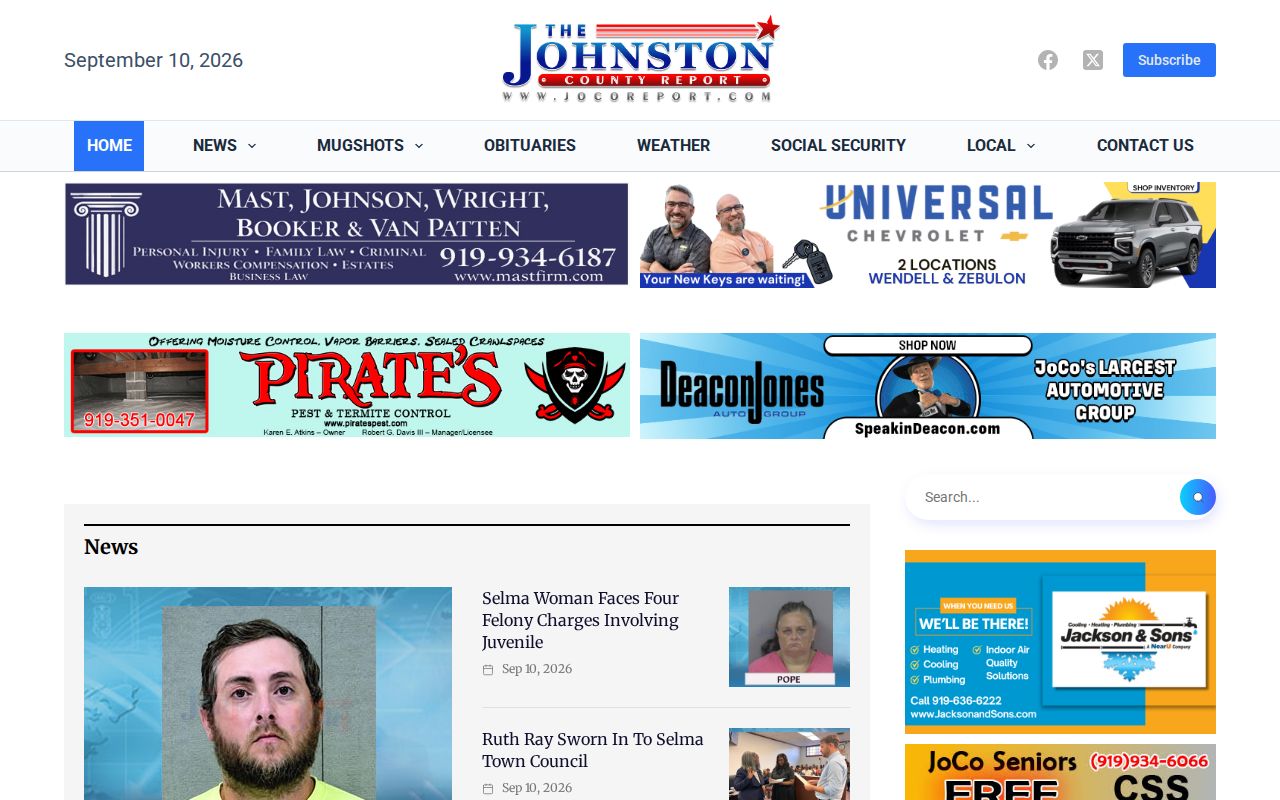
Use local coverage for context, then confirm the arrest through official records. JoCo Report runs event-driven stories. The News & Observer county section and ABC11 Johnston County news cover notable incidents rather than every Johnston County booking. Neither settles custody or court status.
Unofficial Johnston Booking Lists
Commercial pages come only after the official JCSO tools. RecentlyBooked's Johnston page runs a rolling county list, and its search offers name, charge, date, and location filters. Update frequency, counts, and coverage can change without notice. The publisher is not JCSO. An entry may be stale, duplicated, or missing, and the Johnston search interface reflects the site's own filter design.
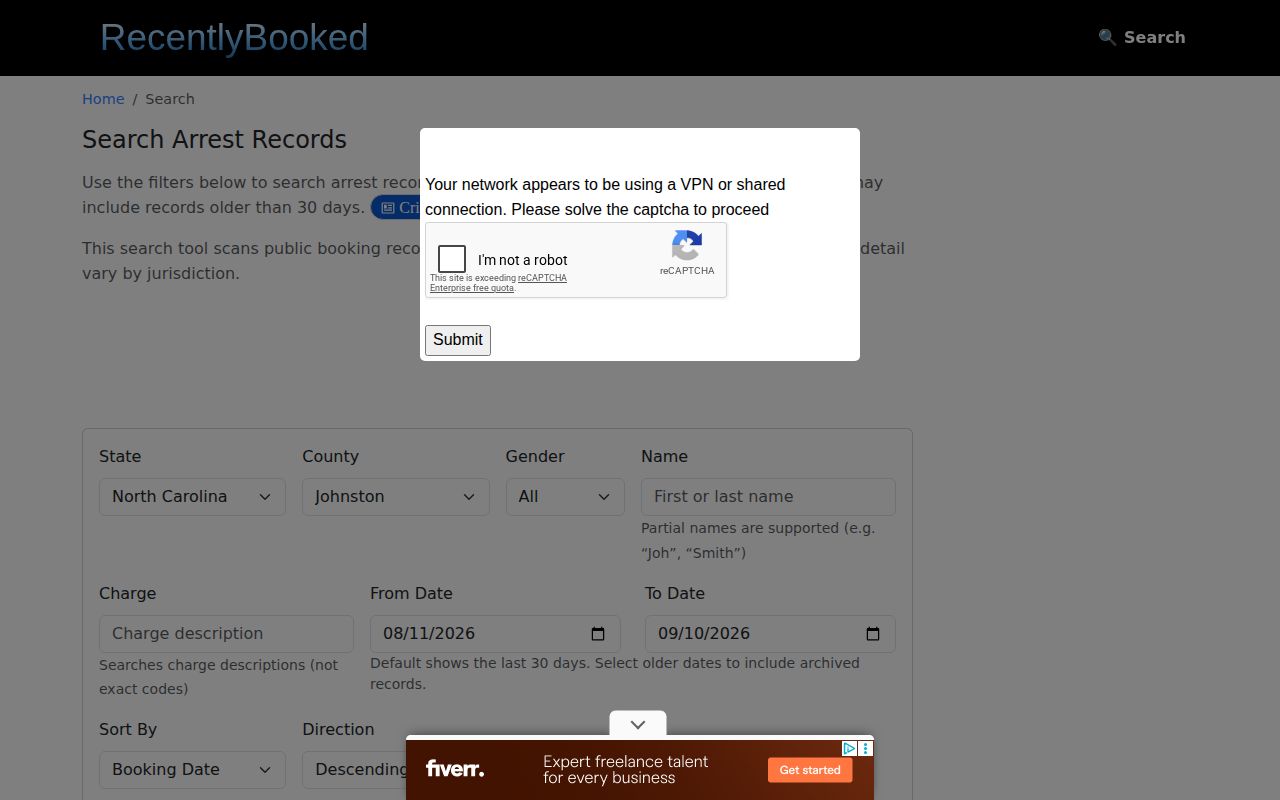
Treat the filters as leads only. Official records settle date and custody. Busted Newspaper's Johnston section lists Johnston County mugshots but returns an access error. Its current fields and timing remain unclear. That uncertainty is one more reason to let JCSO settle the details rather than guessing what the page holds.
Older Johnston Arrest Records
The official arrest search stops at 15 calendar days. JCSO keeps no hidden online archive. No promise covers image visibility either. Once the window closes, request the exact arrest report or booking photo from JCSO, giving the person's name, the date, the arresting agency, and the record type. Court events belong to the Johnston County court entry point or the Clerk.
Retention is separate from web visibility. State Archives schedules govern what agencies keep, not what a portal shows. Identification photos tied to a formal case follow the case file's disposition. One cited schedule lets some photos outside a case file be destroyed after three years. Inmate-classification records follow a separate rule after release or transfer. These are disposal authorizations, not promises about web images.
Older records live elsewhere. The Johnston Heritage Center and State Archives assist with historic newspapers, clippings, and photographs. Neither holds current booking photos. Say plainly whether the request seeks a sheriff record, court file, news clipping, or historic image.
Johnston Arrest News Patterns
News outlets in Johnston County play two different parts when it comes to arrests. The Johnston Ledger runs what looks like a rolling seven-day page. Its rows are coded by agency. JoCo Report, ABC11, and the News & Observer take the other approach. They write event-driven stories when a search warrant, investigation, or public-safety incident breaks. Such a story can explain why several arrests happened at once. Still, it is not a full blotter for that date. Agency codes on the Ledger's page have included JCSO, Clayton Police, Smithfield Police, and Selma Police. Other labels appear there too. Those labels hint at who made the arrest. They say nothing about current custody or release. They also stay silent on how a charge ended in court. For custody status, check with JCSO. For disposition, the Clerk or eCourts is the right stop. Publishers can also change their timing and methods without any notice. A third category sits in the archives. Old Johnston County Sentinel editions carried a "blotter" column of the era. That material suits local-history research. It cannot tell you who sits in the Johnston County jail right now. Treat it as a snapshot, never a live feed.
Request Past Johnston Arrest Logs
Start by knowing what the record is. A Johnston County arrest older than 15 days falls outside the JCSO form. Ask that office instead for a sheriff arrest report or a booking item. City arrests work differently. The police records unit there keeps its own incident reports. For the full criminal case file, contact the Johnston County Clerk. An old newspaper clipping belongs with the Johnston Heritage Center or an archive instead. North Carolina's records schedules let agencies retain or dispose of material. They promise nothing about online access. A booking photograph follows the case file it sits in. Its disposition controls what happens to it. Identification images kept outside a case file can be destroyed. They can be destroyed once that period runs out. Litigation holds, expunctions, confidentiality rules, and later schedules all shift the outcome. Ask the right custodian precisely. Do not assume a universal archive of Johnston County arrests exists.